Every winter, we get calls from homeowners in Coeur d'Alene, Hayden, and Post Falls who notice water stains showing up on their ceilings. No storm. No obvious hole in the roof. Just a slow, mysterious leak that appeared sometime in January or February. Nine times out of ten, the cause is an ice dam.
If you have lived through a few North Idaho winters, you have probably seen one. You might not have known what it was, though. So let us walk through it.
What an Ice Dam Actually Is
An ice dam is a ridge of ice that forms along the lower edge of your roof, right above the eaves. It builds up layer by layer until it creates a wall thick enough to trap melting snow behind it. That trapped water has nowhere to go except backward, up under your shingles, and into your home.
Your shingles are designed to shed water running downhill, not hold back a pool of standing water. So once an ice dam gets big enough, the water behind it finds gaps between shingles, gets into the roof deck, and soaks into your attic, your insulation, your ceilings, and your walls.
Why Ice Dams Form
Here is what is actually happening up there. Heat from inside your house rises into the attic. If your attic is not properly insulated and sealed, that warm air heats up the roof deck. Snow sitting on the warmer upper part of your roof starts to melt. That melt water runs down the slope toward the eaves.
The eaves and overhangs are different. They extend past your exterior walls, so there is no warm living space below them. They stay cold. When that melt water hits the cold overhang, it refreezes. Day after day, the cycle repeats: melt, run, refreeze. The ice ridge gets bigger. Eventually it is thick enough to trap a serious amount of water behind it.
The snow and cold are not the root cause. Heat escaping from your living space into the attic is. That is why some houses on the same street get ice dams every year and the house next door never does. It comes down to insulation, air sealing, and ventilation.
Signs You Might Have an Ice Dam
Icicles hanging from the eaves are the most visible sign. Not every icicle means you have an ice dam, but a thick, continuous ridge of ice along the roof edge with icicles hanging off it is a different story. The more consistent that buildup is, the more likely water is pooling behind it.
Inside the house, look for water stains on ceilings or walls near exterior walls, especially on the upper floor. Peeling paint or bubbling drywall near the roofline is another clue. Sometimes you will notice a damp or musty smell in the attic. All of these can point to water that has worked its way in through an ice dam.
If you are seeing these signs and you are not sure what is going on, a roof inspection can help you figure out whether an ice dam is the cause and how bad the situation is before it gets worse.
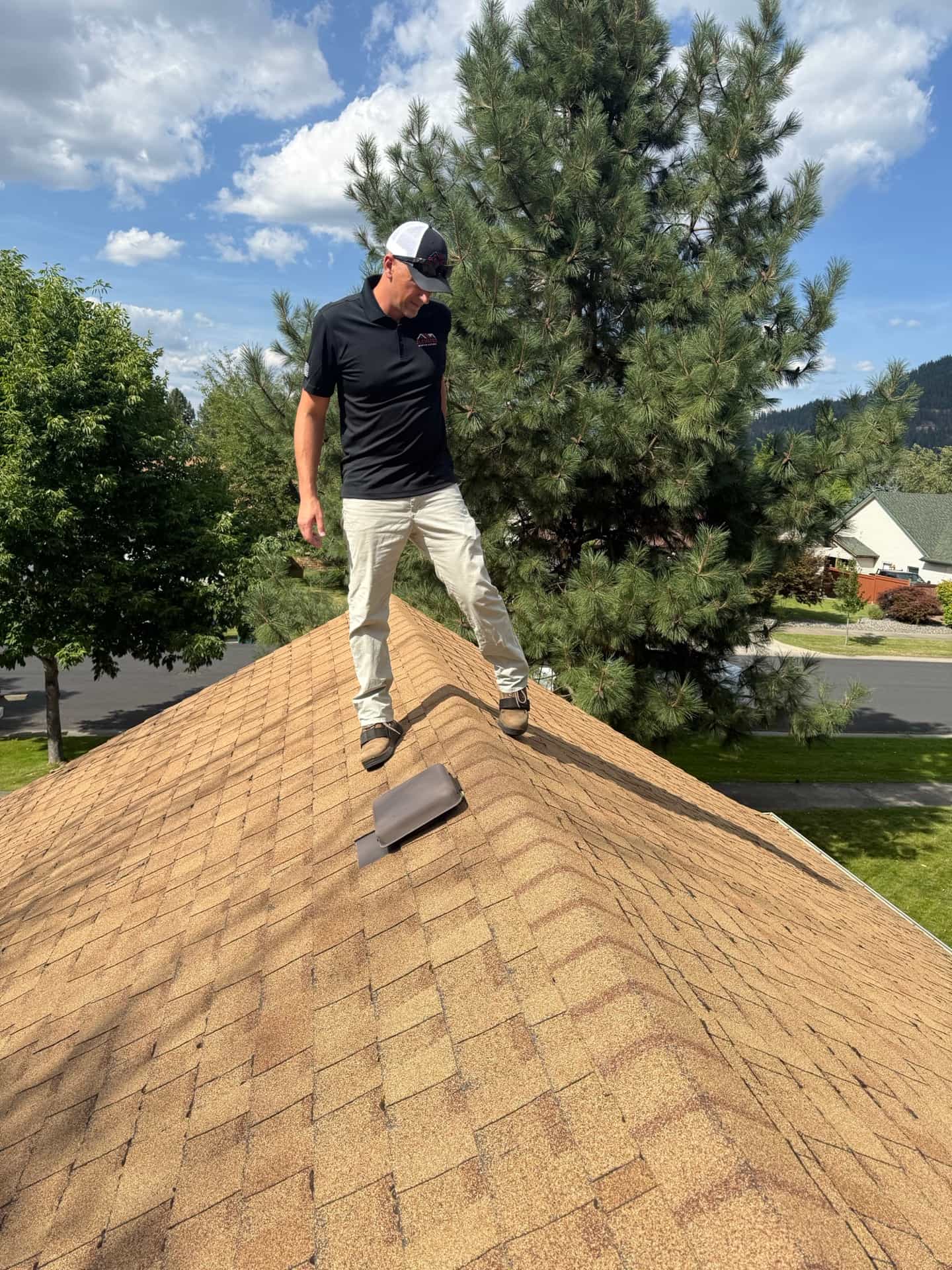
A roof inspection can catch ventilation issues before they cause ice dams.
The Real Fix: Prevention
A lot of people treat ice dams like a winter weather problem. They are not. They are a building envelope problem. The real fix is stopping the heat from escaping your living space into the attic in the first place.
Insulation
For our climate zone here in North Idaho, the recommended attic insulation level is R-49. A lot of older homes in the area have R-19 or R-30, which was fine by the standards of when they were built but is not enough to prevent heat transfer through the attic floor. If your home was built before the early 2000s, it is worth checking your insulation depth. You can do this yourself by popping your head into the attic with a flashlight and a tape measure. If the insulation is less than about 16 inches of blown cellulose or fiberglass, you are probably below R-49.
Ventilation
Proper attic ventilation keeps the underside of your roof deck cold and uniform. Cold air enters through soffit vents at the eaves, flows up the underside of the roof, and exits through ridge vents at the peak. This airflow keeps the roof surface close to the outside air temperature, which means snow melts evenly and slowly instead of melting fast in the middle and refreezing at the edges.
When soffit vents are blocked by insulation, or when there is no ridge vent at all, the system breaks down. We see this all the time on older homes. The insulation was blown in over the soffits, cutting off airflow, and nobody thought twice about it. If you are getting gutters replaced or repaired, it is a good time to check that your soffit vents are clear and working.
Air Sealing
This one is easy to miss. Even with good insulation, warm air can sneak into the attic through small gaps. Recessed light fixtures, bathroom exhaust fans, the attic hatch, plumbing vents, electrical penetrations. All of these create pathways for warm, moist air to reach the attic. Sealing those gaps with caulk, spray foam, or weatherstripping makes a big difference. It is not glamorous work, but it is one of the most cost effective things you can do.
The three things that prevent ice dams: enough insulation (R-49 for our area), proper soffit to ridge ventilation, and air sealing between the living space and the attic. Get all three right and ice dams become a non issue.
Underlayment: Your Backup Plan
Even with good insulation and ventilation, building codes in our area require ice and water shield membrane along the eaves. This is a self-adhesive, waterproof membrane that goes directly on the roof deck before your shingles are installed. It is supposed to extend at least three feet past the interior wall line.
This membrane does not prevent ice dams. What it does is protect the roof deck and your home if water does back up under the shingles. Think of it as your safety net.
If your home was built or re-roofed in the last 15 to 20 years, you probably have it. Older homes may not. If you are considering a full roof replacement, that is the time to make sure proper ice and water shield gets installed, along with improved ventilation at the ridge and soffits. It is much cheaper to address all of it at once than to come back later.
Not sure if your roof has the right underlayment or ventilation? We will come take a look for free.
Schedule a Free InspectionWhat NOT to Do
When you see a big ice dam forming on your roof, the urge to grab a ladder and a hammer is strong. Please do not do that. Hacking at the ice with an axe, a hammer, or a chisel is one of the fastest ways to destroy your shingles and crack the roof deck underneath. You might clear the ice, but you will also punch holes in your roof that will cause far more damage than the ice dam ever would have.
Do not pour rock salt or table salt directly on the roof, either. Salt is corrosive and will eat at metal flashing, gutter systems, and the shingle material itself over time.
Pressure washers are another bad idea. The force of the water can drive moisture underneath shingles and into places it should never reach, and it strips the protective granules off asphalt shingles.
If you need a temporary solution while you figure out the long term fix, the safest option is to fill a leg of pantyhose or a long tube sock with calcium chloride (not rock salt) and lay it across the ice dam so it hangs slightly over the gutter edge. The calcium chloride will slowly melt a channel through the ice and let trapped water drain. It is not pretty, but it works in a pinch without wrecking your roof.
When to Call a Pro
If water is actively leaking into your home, that is an emergency. You need someone up there to address the immediate problem and then figure out what is going on with the roof. A roof repair at that point is about stopping the bleeding first and fixing the underlying issue second.
The other time to call is when ice dams keep showing up year after year. If every January you are dealing with the same ice buildup in the same spot, the dam is a symptom. The actual problem is a ventilation or insulation issue that is not going to fix itself. A roofer who knows what to look for can identify whether your soffit vents are blocked, whether you need more ventilation at the ridge, or whether your attic insulation needs to be topped off.
This Is a North Idaho Thing
We get a specific kind of winter weather here that makes ice dams more common than in a lot of other places. From November through March, our temperatures bounce above and below freezing constantly. A 40 degree afternoon followed by a 20 degree night, week after week, is the perfect recipe for ice dam formation. Add in heavy snowfall, and the conditions stack up fast.
Homes in Hayden, Coeur d'Alene, Post Falls, Rathdrum, and up toward Sandpoint all deal with this. It is one of the most common roof issues we see during winter months, and it is almost always fixable once you understand what is causing it.
Ice dams are not random bad luck. They happen for specific, fixable reasons. If you are not sure where your home stands, a quick inspection can tell you a lot. We will look at your ventilation, check accessible insulation levels, examine your underlayment situation, and give you a straight answer about what, if anything, needs to happen.