North Idaho winters are not gentle on roofs. Heavy snow loads, freeze and thaw cycles, ice building up along the eaves. Your roof takes a beating every year. The good news is that most of the serious winter damage we see could have been prevented. The bad news is that people usually do not find out until water is dripping through their ceiling in January.
This article walks through five things you can look for right now, before winter hits, that will tell you whether your roof needs some attention. None of this requires climbing a ladder. Most of it you can spot from your driveway or your attic.
1. Missing or Damaged Shingles
This is the most obvious one, and you can check it from the ground. Walk around your house and look up at the roof from different angles. You are looking for shingles that are curling up at the edges, cracking down the middle, or just plain gone. If you see bare spots where the dark underlayment or wood decking is showing through, that is your roof's outer armor with a hole in it.
Wind is the big culprit here in North Idaho. Once a shingle starts curling, wind gets underneath it like a lever. It peels that one off, and now the shingles next to it are exposed on their edges too. One missing shingle in June becomes five missing shingles by October. It is not an emergency on day one, but it is a problem that gets worse fast. And once winter hits, nobody wants to be up on a roof doing repairs in the snow if they can help it.
If you notice a few shingles that look off, it is worth getting someone up there before the weather turns. A small patch job now is simple. Waiting until spring means your roof spends the whole winter with gaps in its defense.
2. Granule Loss in Your Gutters
This one is sneaky because most people do not know what to look for. Asphalt shingles are coated with tiny sand-like granules. Those granules are what protect the shingle from UV rays and water. Over time, they wear off. That is normal. But the rate of loss matters.
If your roof is new, you will see some granules in the gutters during the first year or two. That is just the loose stuff washing away and it is nothing to worry about. But if your roof is 10 years old or more and you are finding piles of granules in your downspout splash guards or settled at the bottom of your gutter channels, pay attention. The shingles are breaking down and losing the coating that makes them work.
Shingles without granules absorb more heat, age faster, and lose their water resistance. It is a cycle that speeds up once it starts. If you clean your gutters in the fall and you see more grit than usual, that is your roof telling you something. Get it checked before winter, not after the leak shows up.
3. Sagging or Soft Spots on the Roofline
Stand in your front yard and look at the ridge line of your roof. It should be straight. Now look at the planes of the roof on each side. They should be flat and even. If you see any dipping, bowing, or areas that look like they are sinking, that is a structural concern. Do not sit on this one.
A sag in the roofline usually means something underneath has weakened. It could be water damage to the decking, which is the plywood layer that sits on top of your rafters. When that plywood gets wet over and over, it starts to rot and lose its strength. It could also be an issue with the rafters themselves, especially in older homes where the framing may not have been built to handle the snow loads we get up here.
Either way, a sag is the kind of problem that does not fix itself and does not stay the same. It gets worse. And when you add 60 to 80 inches of snow on top of a weakened section of roof, that is when you start talking about real structural failure. If your roofline is not straight, call somebody. This is the one item on this list where waiting is genuinely risky.
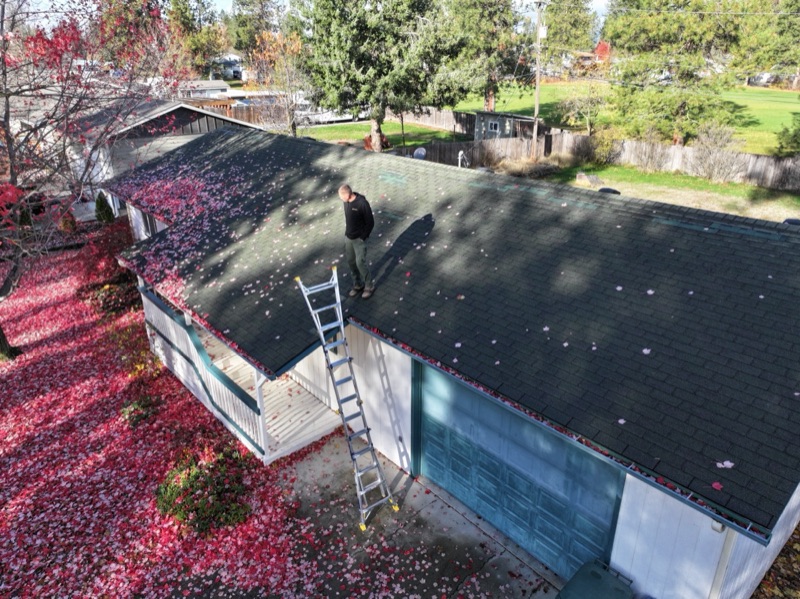
A professional roof inspection covers more than what you can see from the ground.
4. Water Stains on Interior Ceilings or Walls
Brown spots on your ceiling. Yellowish discoloration on the wall near the corner where the roof meets the exterior. A ring of dried water marks around a bathroom vent or a light fixture. These are all signs that water is getting in somewhere it should not be.
Now, a stain on your ceiling does not automatically mean your roof is leaking. It could be a flashing issue around a chimney or vent pipe. It could be a condensation problem caused by poor attic ventilation. It could be an ice dam that forced water back up under the shingles last winter. The stain is just evidence that something let water in. Figuring out the actual source takes a closer look.
The tricky part is that water travels. It can enter your roof at one spot, run along a rafter for several feet, and then drip down onto your ceiling in a completely different location. So the stain on your living room ceiling might be caused by a problem ten feet away on the roof. That is why just looking at the stain from inside does not tell you enough. You need someone on the roof and ideally in the attic to trace it back to the source.
If you see any interior water stains, especially near exterior walls, chimneys, vents, or skylights, get it checked before winter. The freeze and thaw cycles will make any existing entry point worse. Water expands when it freezes. A tiny gap that lets in a little moisture in October will be a bigger gap by December once ice has worked its way in and out a few times.
5. Your Roof Is 15+ Years Old and Has Never Been Inspected
Most asphalt shingle roofs in North Idaho have a practical lifespan of 20 to 30 years. That range depends on the product, the installation quality, the ventilation, and how much abuse the weather dishes out. If your roof is past the halfway mark and nobody has ever been up there to look at it, it is time.
Here is why this matters. Small problems caught early are cheap fixes. A few cracked shingles, a piece of flashing that has pulled away from a vent pipe, a small section of decking that is starting to soften. These are all things that cost a few hundred dollars to repair when you catch them early. The same problems found three years later, after water has been getting in and doing damage the whole time, can mean thousands of dollars or a full replacement.
Think of it like this. You would not drive your truck for 15 years without ever popping the hood. Your roof works the same way. It needs someone to look at it once in a while, especially once it gets past that 15 year mark. The inspection itself is simple and usually takes less than an hour. What it can save you is real money.
A note on roof age: If you are not sure how old your roof is, check your home inspection report from when you bought the house. Your county assessor records may also have the permit date for the last reroof. Or just call us and we can usually tell you the approximate age based on the condition of the materials.
What Happens During a Professional Inspection
A lot of homeowners put off getting an inspection because they are not sure what it involves or they think it is going to lead to a hard sell. Here is what we actually do.
We walk the roof. Every section, every slope. We check the flashing around chimneys, vent pipes, and skylights because those are the most common leak points. We look at the overall condition of whatever material is on your roof, whether that is shingles, tiles, or metal panels. We check the gutters for granule buildup, which tells us how fast the shingles are wearing. We look at your ventilation, because a roof that cannot breathe properly traps moisture and heat, shortening the life of everything on it.
If we can get into the attic, we check there too. We are looking for signs of moisture, mold, daylight coming through where it should not be, and the condition of the insulation. A roof can look fine from the street and have real problems happening on the underside.
After the inspection, we tell you what we found. Plain language, no jargon. If nothing is wrong, we will tell you that. If something needs attention, we will explain what it is, how urgent it is, and what the options are. We are not in the business of scaring people into buying a new roof. If yours has five good years left, we will say so. We are building our name in this area and the only way that works is by being straight with people.
When to Schedule
The ideal time to get your roof inspected is late summer or early fall. That gives you enough time to handle any repairs before the snow and ice season starts. Once November hits in North Idaho, you are basically locked in with whatever condition your roof is in until spring.
That does not mean you should skip it if you are reading this in October or even November. Getting eyes on the problem now is still better than waiting until spring. If there is something that needs fixing, we can at least do temporary measures to get you through the winter safely. But the earlier you catch it, the more options you have and the less it tends to cost.
If your roof has any of the five signs listed above, or if it is past the 15 year mark and nobody has looked at it, now is the time. Give us a call at (208) 551-1359 or reach out through the website. Inspections are free, they take about 30 minutes, and we will tell you exactly what we find. No games, no pressure. Just a straight answer about what is going on up there.